
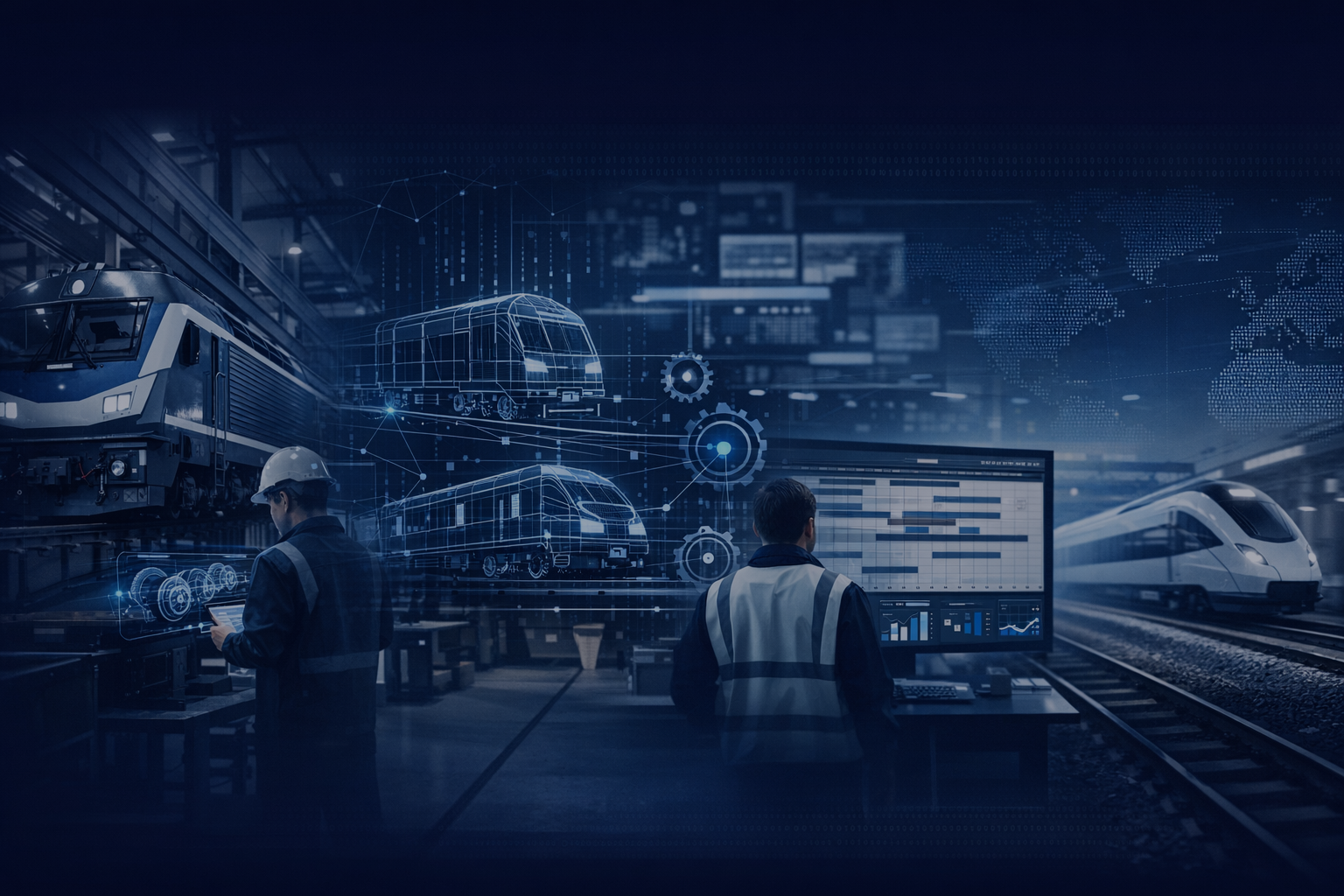

Webinar Synopsis
Are aging fleets, mixed OEM configurations, and constrained depot capacities squeezing your rail operations? Rolling stock maintenance is no longer just a depot-level problem; it is an end-to-end fleet availability and lifecycle governance challenge. In this upcoming webinar, we will explore how rail operators and OEM maintainers can solve the disconnect between engineering data, maintenance planning, and shop-floor execution.
The Challenge Rail operators are increasingly forced to "sweat the asset" as fleets age, procurement delays rise, and physical capex budgets tighten. Organizations struggle with incomplete engineering data continuity, delayed depot readiness for new fleets, and static legacy planning tools that cannot dynamically manage finite track, pit, parts, and labor capacities. This fragmentation leads to wasted capacity, excessive corrective maintenance, and costly fleet unavailability.
We will demonstrate how Dassault Systèmes provides the critical digital orchestration layer to synchronize your maintenance ecosystem:
- Maintenance Engineering: we will show how to establish a governed digital thread that connects OEM engineering baselines, bills of materials, and configurations directly to maintenance rules, preventing costly "configuration drift" and ensuring technical data is perfectly synchronized.
- Maintenance Scheduling with Finite Resources: Discover how DELMIA acts as an advanced orchestration and finite-capacity solver. It takes the maintenance demand and uses complex mathematical constraint solving to dynamically match a specific train to the right workshop bay, skilled technician, and spare parts at the exact right time.
- Maintenance Execution: Learn how to eliminate paper-based processes and improve technician productivity. We will highlight how digital, model-based work instructions guide complex repairs and create a closed-loop system for real-time defect capture that feeds directly back to engineering.
Understand why fleet availability is the ultimate economic bridge for the rail business model. By mathematically optimizing finite resources, digital orchestration prevents "ghost capacity," defers the need for expensive physical infrastructure expansions, and protects against millions of dollars in availability losses and service penalties.
Join us to learn how to transform siloed, reactive maintenance into a fully orchestrated, capacity-feasible operation.
Key Learning Objectives
- Understand how digital orchestration connects engineering data, maintenance planning and shop-floor execution to improve rolling stock maintenance continuity.
- Learn how finite-capacity scheduling can optimize depot resources, including bays, tracks, pits, spare parts and skilled technicians.
- Explore how digital work instructions and closed-loop defect capture can improve technician productivity, reduce rework and support better fleet availability.
 Register
